Your organization, as a working model.
One model of your org — people, costs, skills, programs, networks — that you can see, understand, change, and defend. Runs in your browser, on your machine, live on your own CSV in under a minute.
Organizations aren't trees. Your tool shouldn't pretend they are.
Dotted-line managers are data, not decoration. People carry program and product assignments across department lines, synergy tags mark overlap, vacancies and contractors are first-class node states — and the whole matrix exports to its own slide in the board deck. Beside the chart: a full data grid with nine column groups, inline editing, and saved views.
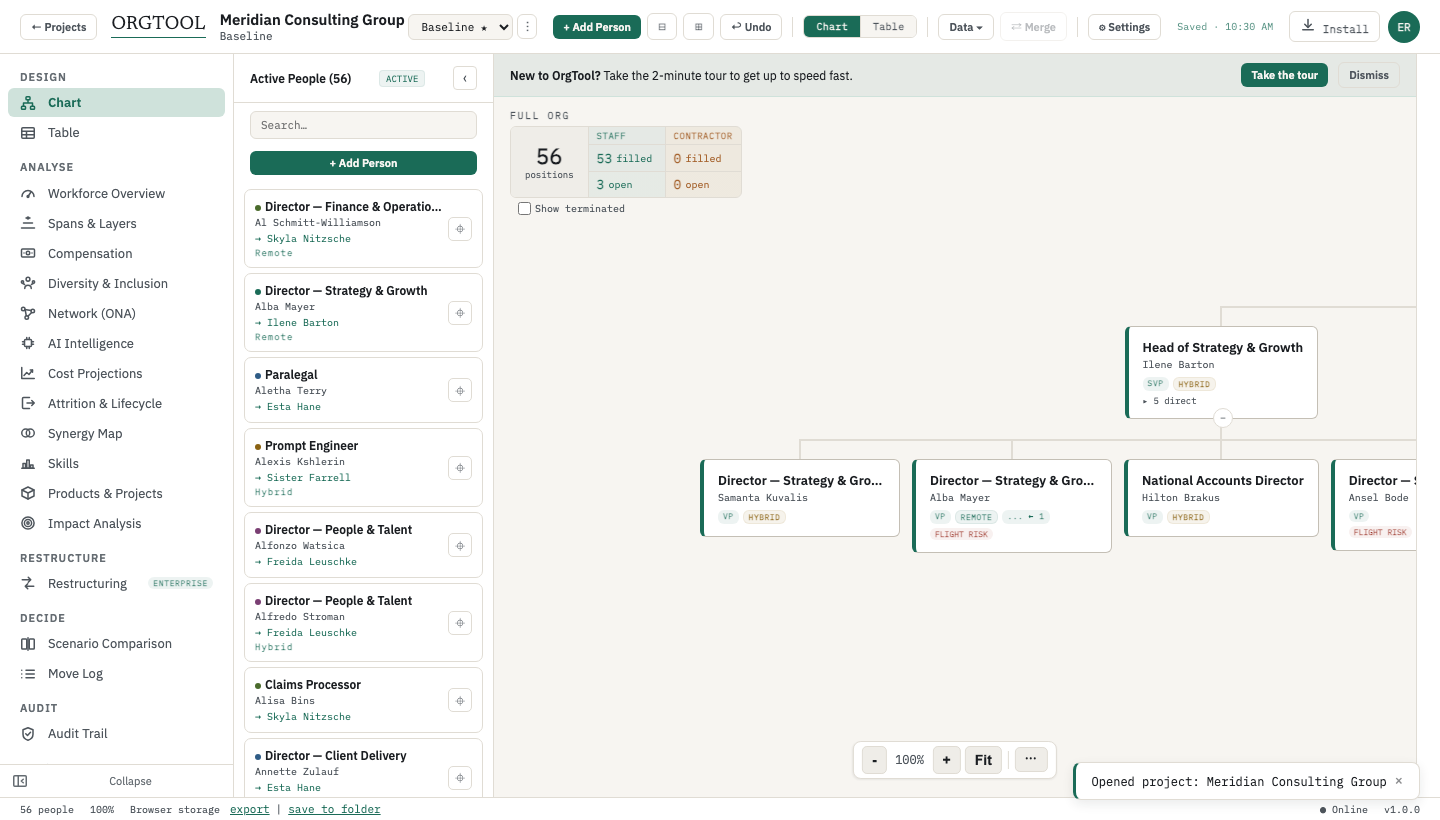
Every node is a computed record. So the chart answers questions.
Health score and risk radar, spans & layers against segment targets, compensation and pay-equity analytics, succession coverage and single points of failure, the informal network in five dimensions, and per-role AI exposure — computed locally, explainable to a board.
Branch. Plan. Merge. Like version control, for the org.
Change is comparison, not edict: unlimited scenarios against a baseline, drag-to-redesign with live cost and span deltas, side-by-side diffs of added, removed, and moved people. Workstream leads plan in parallel on their own machines; OrgTool three-way-merges the copies, surfaces conflicts for a decision, and lands every merge as a version snapshot.
When the change is a reduction, the model becomes the record.
Draw a RIF selection and the EEOC 80% rule, Fisher exact tests, and federal and state WARN thresholds evaluate as you click. When the pack goes to counsel, it carries the full analysis and the hash that proves nothing moved after the fact — the strategic case and the legal record are the same document.
How the audit pack works →CSV to board-ready in one sitting.
The consultant's benchmark: walk in with an export, walk out with the diagnosis and the deck. Every step below is a shipped screen, not a demo script.
Run it on your own CSV- min 0–1 Drop the CSV. Columns auto-map, managers resolve — in your browser.
- min 1–5 Walk the real org. Matrix lines, programs, vacancies, contractors — visible.
- min 5–10 Read the diagnostics. Health score, spans & layers, succession gaps, single points of failure.
- min 10–20 Branch a scenario. Drag the redesign; cost and span deltas update live.
- min 20–25 Compare side by side. Baseline vs proposal: added, removed, moved, and what it costs.
- min 25–30 Export the deck. Client-ready PPTX — per-manager slides, impact summary, matrix slide.
Built for the people in the room when it's decided.
Succession coverage, spans & layers, pay equity — and a board pack that exports itself.
Start at Understand →Client data on your laptop, not your firm’s tenant. CSV to client-ready deck in one sitting.
Run the 30 minutes →Workstream leads branch in parallel and merge with an audit trail; Team licensing per practice.
See Team licensing →Isolated by architecture, deterministic by design, and an audit pack built for counsel review.
Start at Defend →Built for the work that can't leave the building — and the teams just getting started.
Financial services, healthcare, public sector — anywhere the review board's first question is "where does the data live?" Here the answer is short: on hardware you control, offline if you like, in encrypted files you hold. Nothing new for a vendor to hold, nothing new to clear.
Free for one org of up to 25 people: sketch the first real chart, model the hiring plan as scenarios, add grades before comp drifts. The same file grows into the full analytics stack as you do. Start with org design for startups in our Learn library.
Engagement data stays on the consultant's machine, scenarios clone per option under review, and the deliverable exports straight to the client's PPTX template — with an audit trail the client can keep.
Isolation-grade privacy, as a standard feature.
Your org never becomes a vendor tenant. There is no server-side copy to steal, leak, or subpoena.
.orgpack files encrypt with AES-256-GCM under a passphrase only you hold. A separate admin passphrase can cryptographically wall off cost and demographic fields.
Restructuring exports are deterministic and SHA-256-stamped; our Ed25519 key is public, so anyone can verify a pack offline — without an account, without us.
Full function on a plane, at a client site, or in a closed room. Sign in once with an emailed code; the app then works offline for days.
The sensitive plan stays with the people planning it. No new vendor holding workforce data, no addition to the disclosure list.
Buying is a software licence — a signed key, verified locally. Not a DPA negotiation, a security review, or a data-residency workshop.
The modern restructuring library.
Frequently asked questions
Answers restate claims verified file-by-file against the current build — see claims/ in the site repo. Last verified July 2026.
What is OrgTool?
Is a local-first tool less capable than a cloud platform?
Does my org data ever leave my machine?
Is the free plan actually usable?
Does OrgTool integrate with my HRIS (Workday, BambooHR, HiBob)?
Can OrgTool really handle matrix organizations?
Can my team work on the same plan?
Do the AI features see my data?
What do I need to run OrgTool?
OrgTool turns an organization into a working model on the planner's own machine: every person a computed record across cost, skills, succession, retention, networks, and AI exposure, every structure — including true matrix and program assignments — modelled as data. You see the org as it really is, understand it through spans & layers, compensation, diversity, and network analytics, change it through branchable, mergeable scenarios, and when the change is a reduction, defend it with live EEOC 80%-rule, Fisher's exact, and federal + CA/NY/NJ/IL WARN analysis exported as a deterministic, SHA-256-stamped audit pack counsel can verify offline. Org data lives in encrypted .orgpack files, never in a vendor cloud. Free for one org of up to 25 people; Pro from $49 per person per month.