Solutions · Network mapping (ONA)
See the company behind the chart.
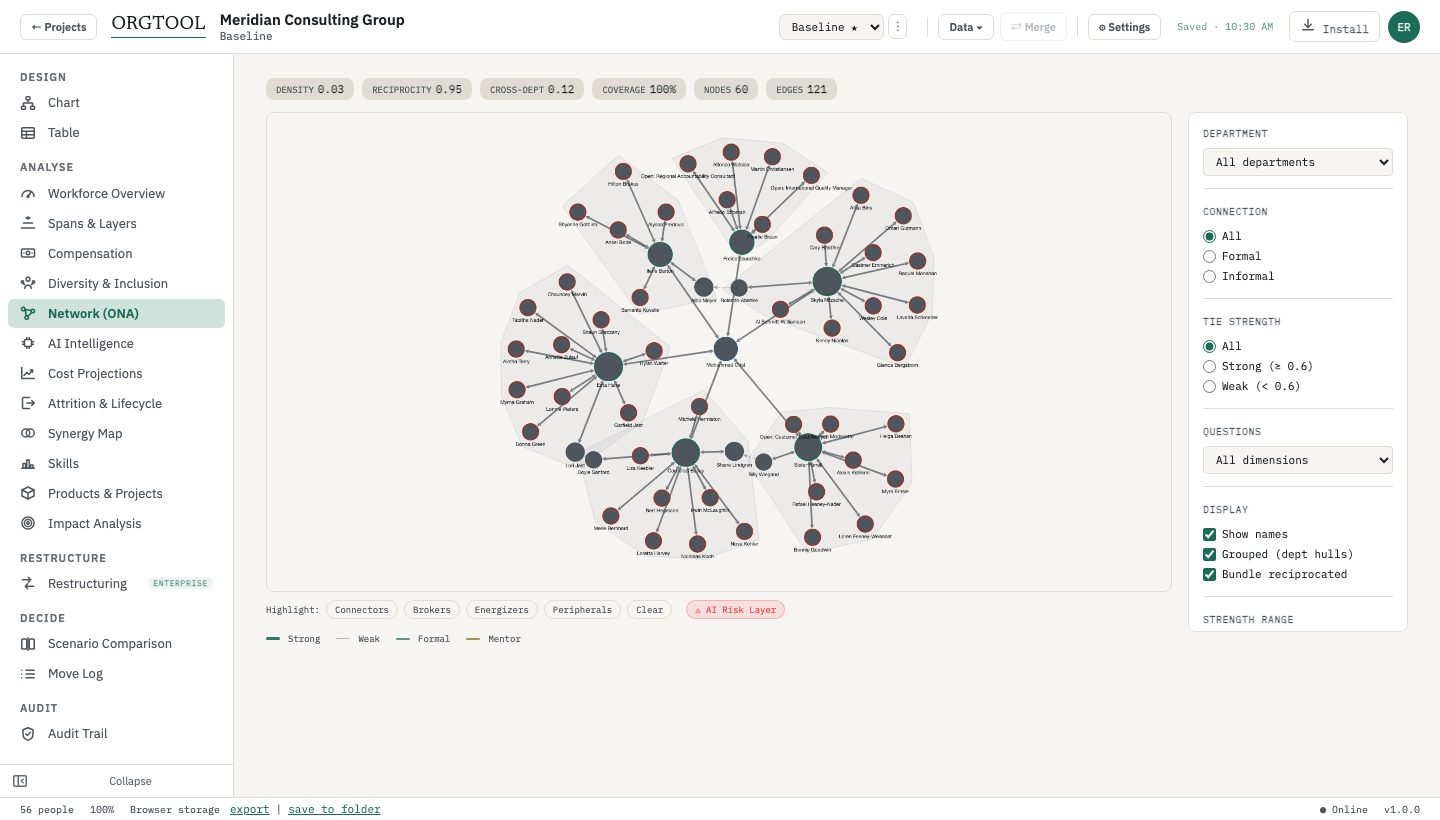
Advice, trust, energy, information, and influence — the informal networks that actually run the company, mapped from declared ties and analyzed with deterministic, explainable graph metrics. No ML, no email mining, no server. Advice and information on every plan; the other three on Team.
Five dimensions, kept separate
Advice, trust, energy, information, and influence networks — mapped as distinct questions, because the advice hub and the trust anchor are rarely the same person. Advice and information are on every plan; energy, trust and influence are on Team.
Deterministic centrality
Brokers, connectors, and gatekeepers found with betweenness centrality — decades-old, explainable graph mathematics. Same ties in, same numbers out; defensible in front of a works council.
Declared ties, not surveillance
Active ONA only: ties are entered deliberately, and the graph math runs locally on your machine. No email mining, no calendar harvesting, no communications metadata — ever.
The AI × network lens
Cross AI exposure with network centrality to find the roles most likely to change held by the people the organization can least afford to lose — before a plan makes them redundant. On Team and above.
SPOF meets the informal org
Network single points of failure surface alongside succession gaps in the risk radar — the chart's blind spots, made visible in the same diagnostic.
Into the deck
Network views and metrics export with the rest of the model — the informal org makes it to the boardroom, not just the whiteboard.
FAQ
Questions people ask
Answers restate claims verified file-by-file against the current build — see claims/ in the site repo. Last verified July 2026.
Is this employee surveillance?
No — by construction. OrgTool implements active ONA only: people declare their ties deliberately, the analysis runs locally on the planner's machine, and no communications data is ever collected. The passive email-mining model raises consent and works-council issues we've deliberately built away from.
Is the analysis a black box?
The opposite: betweenness centrality is deterministic, published graph mathematics (Freeman 1977, Brandes 2001). You can show exactly why every score is what it is — which matters when the output informs decisions about people. The Learn library's ONA guide covers the research canon.
Why does the informal network matter in restructuring?
Because the classic restructuring failure is cutting a role that looked duplicative on paper and turned out to be the only bridge between two functions. Reading centrality alongside AI exposure and succession data is how plans avoid severing the connections that made the old org work.